
A complete step-by-step guide for bloggers, marketers, and SEO beginners to discover low-competition keywords that rank fast using free and paid tools in 2025.
What is a keyword tool and how does it work?
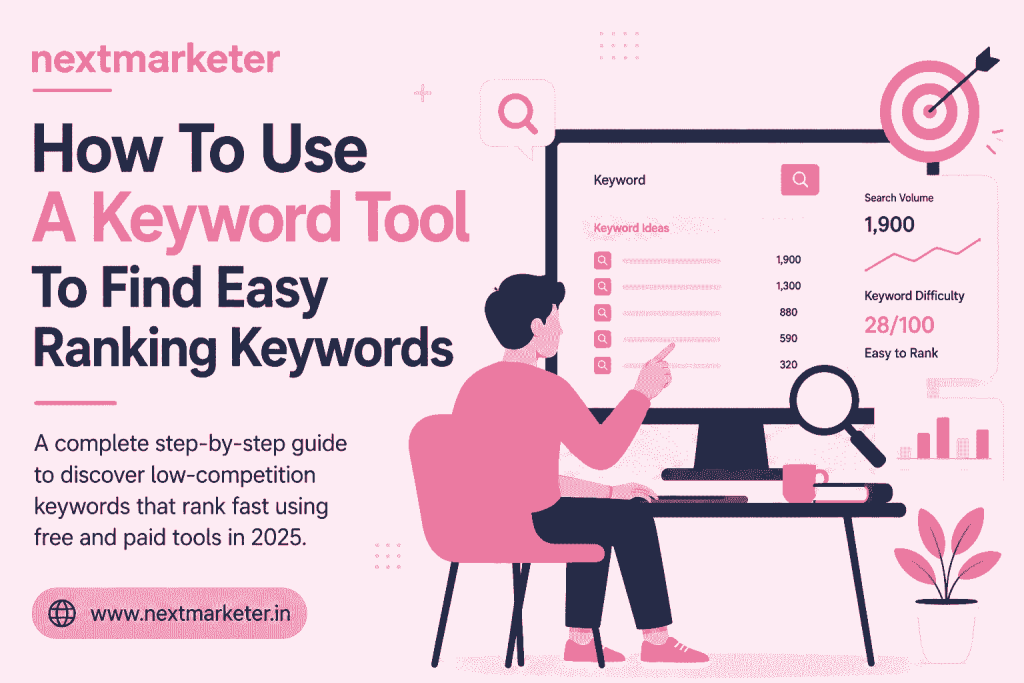
A keyword tool is a software platform that analyses search engine data to show you which terms real users type into Google, Bing, and other search engines. It returns metrics such as monthly search volume, keyword difficulty, cost-per-click (CPC), search trend history, and related keyword ideas — all of which help you decide which topics are worth creating content around.
Every successful content strategy starts with structured keyword research. Without it, you are essentially publishing blindly, hoping your topics match what your audience actually searches for. With a reliable keyword tool, you gain a data-backed roadmap that tells you exactly what to write, in what order, and with what focus — dramatically increasing your chances of ranking on the first page of Google.
The core output of any keyword tool includes three essential data points: search volume (how many people search for a term each month), keyword difficulty (how hard it is to outrank existing results), and search intent (whether users want information, a product, or a specific website). Understanding all three is what separates a high-ranking piece of content from one that gets zero organic traffic.
Why keyword research is the foundation of SEO success
Experienced SEOs treat keyword research as the single most important pre-writing task. Before typing a single word of content, they open a keyword tool, validate demand, assess competition, and map every piece to a specific search query. This approach ensures that every hour spent writing has a measurable ROI.
Effective keyword research helps you understand not just what people search for, but why they search for it. A query like “best free keyword research software” signals someone at the evaluation stage — they are comparing tools and are close to a decision. A query like “how to do keyword research” signals a beginner looking for education. Recognising this difference allows you to craft content that matches intent precisely, which is now one of Google’s strongest ranking signals.
Beyond individual posts, a well-structured keyword research process lets you build topical authority — a cluster of interlinked content that covers an entire subject area comprehensively. Google rewards sites that demonstrate deep expertise in a niche, and a systematic keyword tool-driven approach is the fastest way to build that authority.
Pro tip — start with long-tail keywords: New websites should target phrases of 3–6 words with search volumes between 100–2,000 and difficulty scores below 30. These terms are far easier to rank for and convert at higher rates than broad, competitive head terms.
Best keyword tools in 2026: free and paid options
Choosing the right keyword tool depends on your budget, the depth of data you need, and your technical comfort level. Below is a breakdown of the leading platforms available today, from fully free options to professional-grade suites.
Google Keyword Planner
Google’s own keyword research tool free of charge. Built into Google Ads Keyword Planner, it surfaces search volume, competition, and trend data directly from Google’s index. Ideal for beginners — access it via a free Google Ads account without running any campaigns.
FreeOfficial Google data
Ubersuggest
Created by Neil Patel, Ubersuggest is a freemium platform offering keyword suggestions, difficulty scores, CPC data, and content ideas. Its free tier provides sufficient data for bloggers and small businesses doing light keyword research.
FreemiumGreat for beginners
SEMrush
Industry-leading platform for semrush keyword research. Its Keyword Magic Tool contains 25+ billion keywords. Semrush pricing starts at ~$139.95/month — justified for agencies and scaling businesses that need competitor gap analysis and clustering.
PremiumEnterprise-grade
KWFinder
KWFinder by Mangools is a precision keyword finder designed for low-competition discovery. Its 0–100 difficulty score is highly accurate, and keywords scoring below 30 are generally attainable for new sites. Best for niche bloggers and affiliate marketers.
AffordableNiche sites
Google Keyword Search
Beyond the planner, a keyword search tool Google offers is the search bar itself — autocomplete, “People Also Ask,” and “Related searches” sections are free, first-party sources of genuine user intent data that every marketer should mine daily.
FreeReal-time intent
Google Keyword Planner Free
The Google Keyword Planner free mode (without active ad spend) shows volume in ranges (e.g., 1K–10K). Pair it with Google Search Console’s performance report to get exact click and impression data for keywords your site already partially ranks for — a powerful zero-cost combination.
FreePair with GSC
Free vs. paid keyword tools: quick comparison
| Feature | Free tools | Paid tools |
|---|---|---|
| Search volume data | Ranges / estimates | Exact monthly figures |
| Keyword difficulty score | Basic or absent | Precise, algorithm-backed |
| Competitor keyword analysis | Limited or none | Full gap analysis |
| Keyword clustering | Manual only | Automated |
| SERP feature tracking | Not available | Featured snippets, PAA, maps |
| Best for | Beginners, tight budgets | Agencies, scaling sites |
Step-by-step: how to find easy ranking keywords
- Define your niche and seed topics – Before opening any keyword tool, write down 5–10 seed topics that describe your blog’s core subject. For a marketing blog, seeds might include: “keyword research,” “SEO strategy,” “content marketing,” or “Google Ads.” These seeds are your entry points into the keyword discovery process.
- Enter seeds into your chosen keyword tool – Open your preferred platform — whether that is the Google Keyword Planner, KWFinder, or Ubersuggest — and enter each seed keyword. Review the suggestion list and look for long-tail variations (3+ words), question-format queries, and local modifier variants. These tend to be the easiest to rank for.
- Filter by volume and difficulty – For new sites (DA under 20), target monthly search volume of 100–2,000 with keyword difficulty below 30. For established sites (DA 30–50), expand the range to 1,000–10,000 with difficulty up to 50. A keyword research tool free option like the Google Keyword Research Tool is sufficient for this filtering step.
- Analyse search intent for every keyword – Every term has a dominant intent: informational (“how to use a keyword tool“), commercial (“best keyword research tool“), transactional (“semrush pricing plans”), or navigational (“google keyword planner login”). Your content format must match the intent shown by the top 10 SERP results, or Google will not rank you regardless of quality.
- Manually inspect the SERP for real competition – Even if a keyword planner tool shows a low difficulty score, open Google and examine the actual results page. Are big-authority domains dominating? Is the top-ranking content thin or outdated? Are backlink counts low (under 30)? A SERP with weak content and low-authority pages is your green light to target that keyword.
- Build content clusters around your winners – Group related keywords into a pillar + cluster architecture. A pillar page targets the broad head term (e.g., “keyword research tools”) while cluster pages target specific long-tails (“how to use Google Keyword Planner free,” “KWFinder vs Ubersuggest”). Internal linking between cluster pages signals topical depth to Google and accelerates ranking timelines for the entire group.
- Track, measure, and refine quarterly – Use Google Search Console combined with your keyword tool to monitor ranking progress. Keyword search volumes shift with trends and seasonality — run a quarterly audit using the keyword planner to refresh existing pages and identify new opportunities before your competitors do.
A keyword tool is an SEO software that helps you discover what people search for on Google and other search engines. It provides data like search volume, keyword difficulty, CPC, and related keyword ideas to help you create content that can rank higher in search results.
Google Keyword Planner is still one of the best free keyword research tools in 2026 because it provides real search data directly from Google. Other popular free tools include Ubersuggest and Google Search autocomplete suggestions.
To find low competition keywords:
Use a keyword tool like Google Keyword Planner or KWFinder
Target long-tail keywords (3–6 words)
Choose keywords with difficulty below 30
Focus on search volumes between 100–2,000
Analyse weak competitors in Google SERP results
Keyword difficulty is a metric that estimates how hard it is to rank on the first page of Google for a specific keyword. Lower difficulty scores usually mean easier ranking opportunities for new websites.
Pingback: AI TOOLS 50+ Free ChatGPT Prompts for Bloggers Complete Guide - Nextmarketer